The remaining impacted teeth are found in the middle of supporting bone but stuck in an elevated position above the roots of the adjacent teeth or out to the facial side of the dental arch.
The older the patient, the more likely an impacted canine will not erupt by nature’s forces alone even if the space is available for the tooth to fit in the dental arch. It is important to determine whether all the adult teeth are present or are some adult teeth missing. Are there extra teeth present or unusual growths that are blocking the eruption of the canine? Is there extreme crowding or too little space available causing an eruption problem with the canine?. The oral surgeon will also need to remove any extra teeth (supernumerary teeth) or growths that are blocking eruption of any of the adult teeth. If the eruption path is cleared and the space is opened up by age 11 or 12, there is a good chance the impacted canine will erupt with nature’s help alone. If the canine is allowed to develop too much (age 13-14), the impacted canine will not erupt by itself even with the space cleared for its eruption.
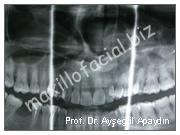
If the patient is too old (over 40), there is a much higher chance the tooth will be fused in position (Figure 5). In these cases the tooth will not budge despite all the efforts of the orthodontist and oral surgeon to erupt it into place. Sadly, the only option at this point is to extract the impacted tooth and consider an alternate treatment to replace it in the dental arch .
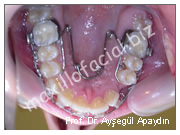
In cases where the canine will not erupt spontaneously, the orthodontist and oral surgeon work together to get these unerupted canines to erupt. Each case must be evaluated on an individual basis but treatment will usually involve a combined effort between the orthodontist and the oral surgeon. Generally a space will be opened to provide room for the impacted tooth to be moved into its proper position in the dental arch(Figure 6). If the baby canine has not fallen out already, it is usually left in place until the space for the adult canine is ready. Once the space is ready, the orthodontist will refer the patient to the oral surgeon to have the impacted canine exposed and bracketed.
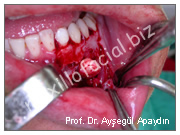
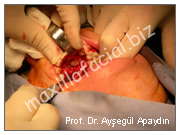
In a simple surgical procedure performed in the surgeon’s office, the gum on top of the impacted tooth will be lifted up to expose the hidden tooth underneath. If there is a baby tooth present, it will be removed at the same time. Once the tooth is exposed, the oral surgeon will bond an orthodontic bracket to the exposed tooth. The bracket will have a miniature gold chain attached to it. Sometimes the surgeon will leave the exposed impacted tooth completely uncovered by suturing the gum up high above the tooth or making a window in the gum covering the tooth. Most of the time, the gum tissue will be returned to its original location and sutured back with only the chain remaining visible as it exits in the future position of the tooth (Figure 7).
The goal is to erupt the impacted tooth and not to extract it! Once the tooth is moved into the arch in its final position, the gum around it will be evaluated to make sure it is sufficiently strong and healthy to last for a lifetime of chewing and tooth brushing. In some circumstances, especially those where the tooth had to be moved a long distance, there may be some minor “gum surgery” required to add bulk to the gum tissue over the relocated tooth so it remains healthy during normal function.
These basic principals can be adapted to apply to any impacted tooth in the mouth. It is not that uncommon for both of the maxillary canines to be impacted. In these cases, the space in the dental arch form will be prepared on both sides at once. The anterior teeth (incisors and canines) and the premolar teeth are small and have single roots, they are easier to erupt if they get impacted than the posterior molar teeth. The molar teeth are much bigger teeth and have multiple roots making them more difficult to move. The orthodontic maneuvers needed to manipulate an impacted molar tooth can be more complicated because of their location in the back of the dental arch.


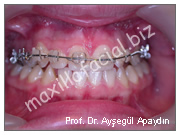
 Impacted Canine